The former site of Al Capone’s longtime Palm Island estate has sold for $21 million, extending the turnaround of one of Miami Beach’s most storied bayfront parcels, according to PROFILEmiami. The transaction closed at 93 Palm Avenue on Palm Island, where the original residence tied to the Prohibition-era figure was demolished in 2023.
The sale is notable both for its price and for what the property has become: a vacant waterfront development site with 100 feet of Biscayne Bay frontage in one of Miami Beach’s most tightly held residential enclaves. Public records cited by PROFILEmiami show the parcel last changed hands for $15.5 million, meaning the latest trade marks a sharp increase in value even without a house on the lot.
Also read: Reagan Landing Planned as 424 Unit Bradenton Community
Jordan Karp of Jordan Karp LLC and Joel Lusky of The Brokerage South Florida represented the seller, while Mirce Curkoski and Albert Justo of ONE Sotheby’s International Realty represented the buyer, according to the report and public records.
What changed at 93 Palm Avenue
Before the site was cleared, 93 Palm Avenue was best known as the former home of Al Capone, who acquired the property in 1928. The original Colonial-style residence dates to 1922 and was once part of an approximately 30,000-square-foot estate. After Capone bought it, he reportedly invested about $200,000 into improvements that included a gatehouse, a seven-foot wall, searchlights, a cabana and a coral rock grotto.
The property remained in the Capone family for decades before Mae Capone sold it in 1952. More than 70 years later, the aging structure was demolished in August 2023 after a lengthy preservation dispute and amid concerns about flooding and the home’s condition.
The demolition followed changes to Florida law that limited local preservation authorities’ ability to stop certain single-family homes from being demolished if the owner opposed historic designation and the property sat in a designated flood zone or below base flood elevation. In this case, the Miami Beach Historic Preservation Board canceled a scheduled hearing after losing jurisdiction under the revised rules.
Why the estate drew preservation attention
The Capone connection made the property one of Miami Beach’s better-known historic residential sites, but the building’s physical condition became central to the debate. Previous owners and developers maintained that the house sat roughly three feet below sea level, had repeated flooding issues and would require substantial repairs.
That created a familiar South Florida tension: whether an aging, historically important home should be preserved or replaced when flood risk and maintenance costs become too high. In the case of 93 Palm Avenue, the legal and regulatory landscape ultimately shifted in favor of demolition.
For readers tracking the history of the site, PROFILEmiami previously documented the estate before it was torn down in its earlier coverage of the property’s market history and original residence.
A vacant waterfront site now back on the market cycle
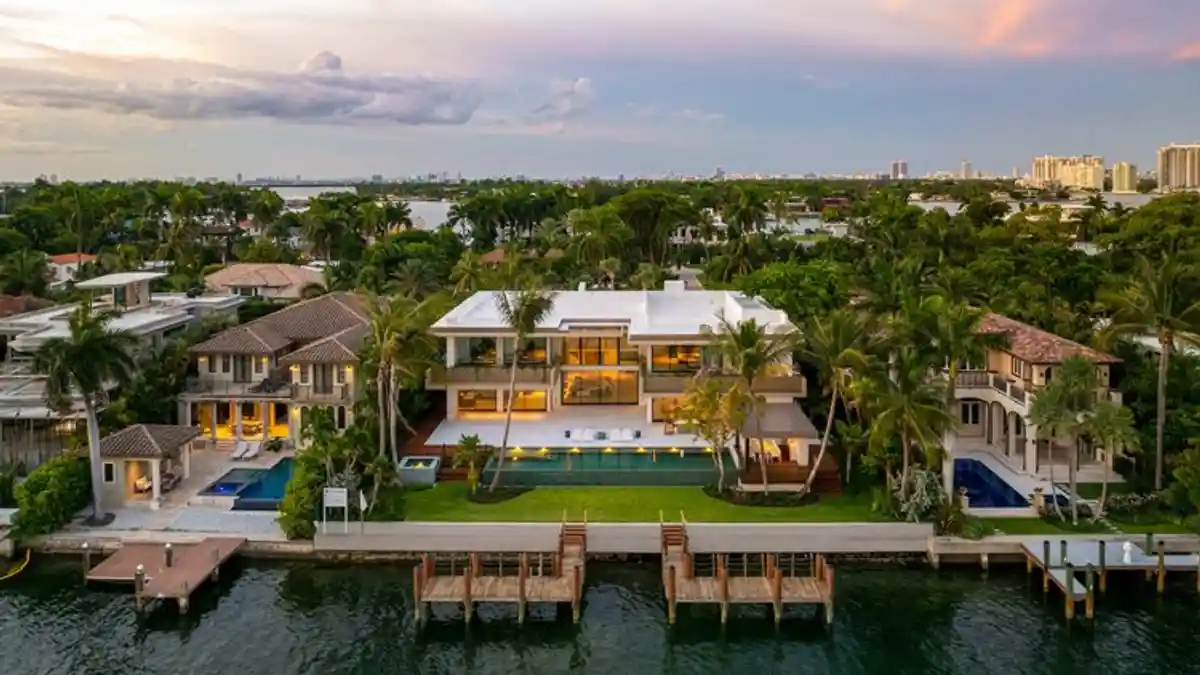
With the residence gone, the parcel is now a blank slate on Palm Island, a neighborhood that continues to attract ultra-luxury buyers seeking large waterfront lots and direct bay access in Miami Beach. The site’s value is tied not only to its history, but also to its land characteristics: a bayfront location, 100 feet of frontage and a place within one of Miami-Dade’s most exclusive residential islands.
While the new owner has not publicly detailed redevelopment plans, the parcel’s sale suggests market demand remains strong for rare teardown and redevelopment opportunities on Miami Beach’s private islands. That demand has repeatedly been visible across Palm Island, Hibiscus Island and Star Island, where waterfront land trades at premium levels because of limited supply and scarcity of buildable bayfront lots.
The Capone site is part of that broader pattern. Even without an existing home, the property’s historical associations and waterfront positioning helped it command a price well above its prior sale.
| Project Detail | Information |
|---|---|
| Address | 93 Palm Avenue, Palm Island, Miami Beach |
| Property Type | Vacant waterfront residential development site |
| Frontage | 100 feet on Biscayne Bay |
| Latest Sale Price | $21 million |
| Prior Sale Price | $15.5 million |
| Original Residence | Built in 1922; demolished in 2023 |
| Historical Owner | Al Capone acquired the estate in 1928 |
Palm Island remains one of Miami Beach’s most watched enclaves
Palm Island has become one of the clearest barometers of Miami Beach luxury land values. The neighborhood’s guarded access, bayfront lots and proximity to South Beach continue to draw interest from wealthy buyers, developers and trophy-home investors, particularly when a parcel offers wide water views and redevelopment potential.
Recent sales across Miami Beach’s private islands have underscored that competition for waterfront land remains intense. The Capone site’s $21 million trade fits within that pattern, where location and lot characteristics can outweigh the absence of a finished residence.
At 93 Palm Avenue, history no longer sits on the lot in physical form. But the property’s identity, shaped first by Capone’s ownership and later by the preservation fight that followed, remains part of what gives the site its market profile today.